
The fastest renter is not always the one with the highest income. It is often the one with the cleanest application.
When you are applying for apartments for rent in Toronto, landlords usually want documents that prove three things:
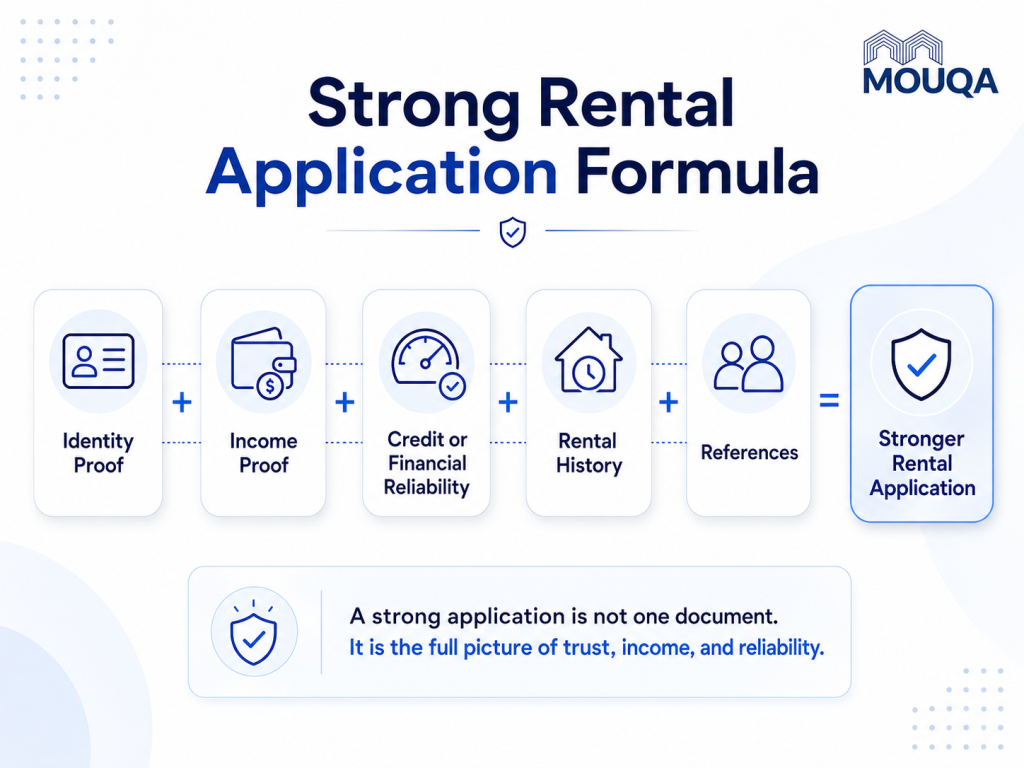
Who you are?
Whether you can afford the rent?
Whether you are likely to be a reliable tenant?
Quick Answer
To apply for apartments for rent in Toronto, you usually need photo ID, proof of income, an employment letter or job confirmation, a credit report or permission for a credit check, rental history, references, and sometimes a completed rental application form. The stronger and more organized your documents are, the faster you can apply when the right apartment becomes available.
In Ontario, landlords may ask for income information, credit references, rental history, and credit checks, but income information should be considered together with other information rather than used alone.
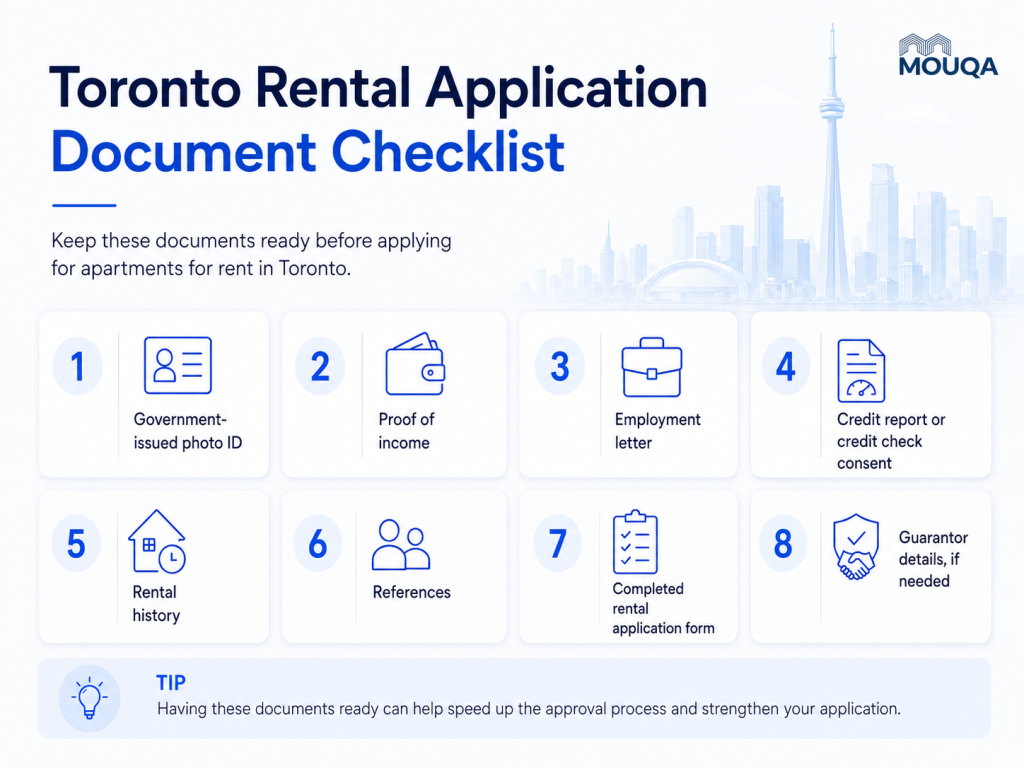
Documents Checklist for Apartments for Rent in Toronto
Before applying for apartments for rent in Toronto, keep your rental documents ready in one place. A complete application package helps landlords review your profile faster and reduces delays when the right apartment becomes available.
| Number | Document | Purpose | Best Tip |
|---|---|---|---|
| 1 | Government-issued photo ID | Confirms your identity | Use a passport, driver license, Ontario photo card, or PR card |
| 2 | Proof of income | Shows you can afford the rent | Keep recent pay stubs, bank statements, or tax documents ready |
| 3 | Employment letter | Confirms job and income stability | Ask for a recent letter with your role, salary, and employer details |
| 4 | Credit report or credit check consent | Helps landlords review financial reliability | Prepare a recent credit report if available |
| 5 | Rental history | Shows your past renting behavior | Include previous addresses and landlord contact details |
| 6 | References | Helps landlords verify reliability | Use previous landlords, employers, or professional references |
| 7 | Completed rental application form | Organizes your information for review | Fill it carefully and honestly |
| 8 | Guarantor details, if needed | Supports limited income, credit, or rental history | Useful for students, newcomers, or first-time renters |
Quick Preparation Tips
- Save everything in one digital folder
- Use recent documents only
- Ask references before sharing their details
- Prepare a guarantor if your profile is limited
- Review everything before submitting
Why This Matters
A strong rental application is not just about having documents. It is about making the landlord’s decision easier. When your documents are ready, you can apply faster, avoid unnecessary delays, and improve your chances of securing the right apartment. For renters using Mouqa, this also makes the digital application and leasing process smoother and more convenient.
Why Documents Matter More in Toronto’s Rental Market
Toronto’s rental market has changed. Renters may have more options in some segments, but strong apartments still move quickly.
CMHC reported that Canada’s purpose-built rental vacancy rate rose to 3.1% in 2025, up from 2.2% in 2024, because of increased supply and softer demand. For the Greater Toronto Area, CMHC reported that purpose-built rental vacancy climbed to 3.0%, while condo apartment vacancy remained tighter at 1.0%.
This means renters may see more listings, but the best units are still competitive. In practical terms, the renter who has documents ready can move faster than someone who starts collecting paperwork after finding an apartment.
Market Insight
The application is not just paperwork. It is part of your competitive advantage. If two renters like the same apartment, the one with complete documents, proof of income, and clear references is easier for a landlord to evaluate.
1. Government-Issued Photo ID
A landlord usually needs to confirm your identity before approving an application. Common forms of ID include a passport, driver license, Ontario photo card, or permanent resident card if applicable.
Practical Tip
Do not send sensitive ID documents casually to random listings. Share documents only after you are confident the listing is legitimate and the landlord or platform is trustworthy. This is one reason verified rental platforms matter. When renters use platforms like Mouqa, they can focus on verified listings and reduce the risk of wasting time on suspicious or outdated posts.
2. Proof of Income
Proof of income helps the landlord understand whether you can afford the rent. Common proof of income documents include recent pay stubs, bank statements, employment income records, Notice of Assessment for self-employed renters, and offer letters or contracts for new employees.
What Landlords Are Usually Looking For
Landlords typically want to see stable and sufficient income. However, income should not be assessed in isolation. In Ontario, the OHRC explains that income information must be considered together with credit references, rental history, and credit checks.
Practical Insight
A strong income document does two things: it shows the landlord you can pay rent, and it reduces friction in the approval process. If your income is irregular, include extra context instead of leaving the landlord to guess.
3. Employment Letter or Job Confirmation
An employment letter gives landlords confidence that your income is stable. A strong employment letter should usually include your full name, job title, employment status, start date, salary or income confirmation, and employer contact information.
For Newcomers or New Employees
If you recently moved to Toronto or just started a new job, an offer letter may help. You can also include savings proof, references, or a guarantor if needed. This is important because many renters lose time trying to explain their situation after applying. A clear document package answers questions before they become delays.
4. Credit Report or Credit Check Consent
Many landlords ask for a credit report or permission to run a credit check. A credit report helps show payment history and financial reliability. If your credit history is strong, having a recent report ready can speed up the application.
If your credit history is weak or limited, especially if you are new to Canada, you can support your application with proof of savings, an employment letter, a guarantor, strong references, and an upfront explanation.
Important Note
A weak or limited credit history does not automatically mean you cannot rent. It means you may need to strengthen the rest of your application.
What If You Are New to Canada?
If you are new to Canada, renting an apartment in Toronto can feel difficult at first, especially if you do not have Canadian credit history yet. But that does not mean you cannot rent.
Credit history is one of the biggest early challenges for newcomers. A 2025 TD survey found that 79% of new Canadians who applied for credit said building credit history in Canada was challenging. This matters because many landlords use credit checks as part of the rental application process. Source: TD New Canadians Credit Survey
If you do not have Canadian credit history, your goal is to make the rest of your application easy to trust. You can strengthen your rental application with an employment letter or job offer, proof of savings, recent pay stubs if available, international rental references, professional references, guarantor information if needed, and a short explanation of your situation.
The key is to show that you are financially prepared and serious about renting. A simple, organized application can make a big difference. Platforms like Mouqa can also help by making the process easier to manage digitally. You can browse verified apartments for rent in Toronto, connect directly with landlords, and move through the application and leasing process with less confusion.
5. Rental History
Rental history helps landlords understand how you handled previous tenancies. You may be asked for previous addresses, former landlord names, former landlord contact details, length of tenancy, and reason for moving.
If You Are a First-Time Renter
If you do not have rental history, you can still strengthen your application with employment proof, references, a guarantor, proof of savings, and clear communication. This is especially useful for students, newcomers, and people moving out for the first time.
6. References
References help landlords verify that you are reliable. Strong references can include previous landlords, employers, managers, and professional contacts. Avoid using weak references who cannot speak clearly about your responsibility or reliability.
Practical Tip
Tell your references in advance that a landlord may contact them. This avoids delays and makes your application look more prepared.
7. Completed Rental Application Form
Many landlords use a rental application form to collect basic information. This can include your name, contact information, employment details, rental history, references, and consent for verification. The application should be accurate and complete. Missing information can slow down approval.
What Competitors Often Miss
Many renters treat the application form like a formality. It is not. A rental application is often the landlord’s first full impression of you. If it is incomplete, inconsistent, or rushed, it can weaken your chances even if your income is strong.
8. Guarantor Information, If Needed
A guarantor may be helpful if your income, credit history, or rental history is limited. This can apply to students, first-time renters, newcomers, renters with limited Canadian credit history, and renters with irregular income. A guarantor is someone who agrees to support the rent obligation if the tenant cannot pay.
Practical Insight
A guarantor does not make an application weak. In many cases, it makes the application easier to approve because it reduces risk for the landlord.
What Landlords Can Ask for When Renting an Apartment in Toronto?
Simple Rule for Renters
A landlord can evaluate financial reliability. A landlord cannot discriminate based on protected grounds. This matters because renters should know the difference between a normal application requirement and an unfair screening practice.
What Happens After Rental Application Approval in Ontario?
Why This Matters
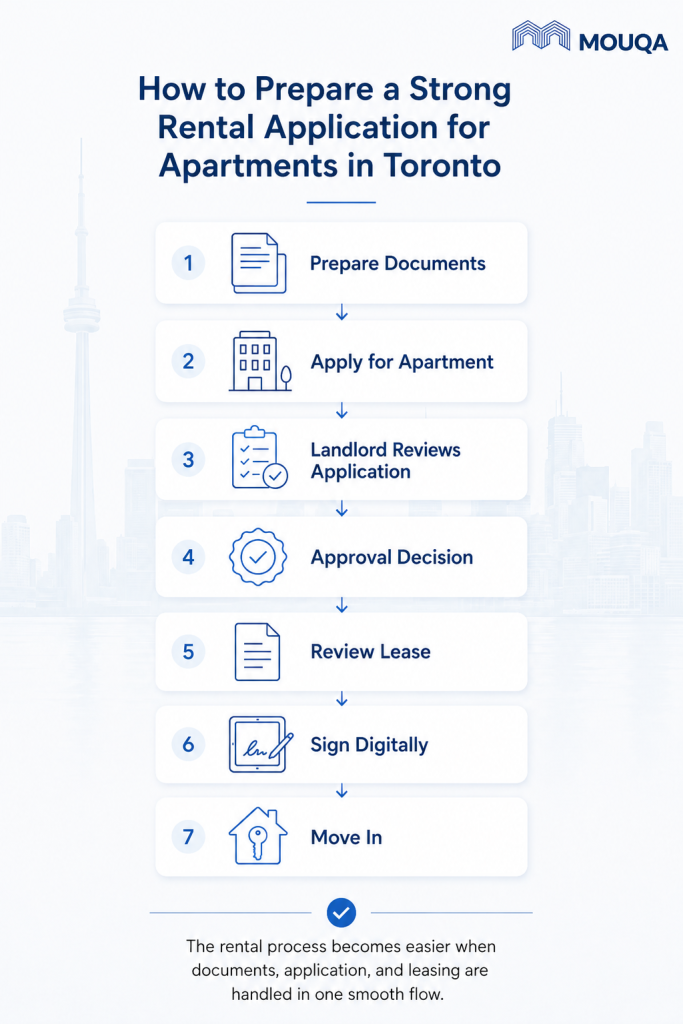
Your documents help you get approved. The lease confirms the legal rental agreement. Before signing, review rent amount, lease term, deposit details, included utilities, parking or storage, rules and responsibilities, and move-in date.
How Mouqa Makes the Rental Application Process Easier
Most renters lose time because the process is scattered. They search on one platform, message somewhere else, send documents manually, wait for replies, and then handle lease steps separately.
Mouqa helps simplify the process by allowing renters to move through the journey more efficiently.
- Browse verified listings
- Compare apartments by location and budget
- Connect directly with landlords
- Apply digitally
- Complete leasing with less back-and-forth
This is especially useful for renters searching for apartments for rent in Toronto, where speed, trust, and convenience can make a real difference.
What Should Renters Do Next?
Before applying, take these steps:
- Decide your budget
- Choose your preferred Toronto areas
- Prepare your document package
- Check your credit report
- Ask references for permission
- Use verified listings
- Apply digitally when you find the right apartment
The goal is not just to apply. The goal is to apply with confidence.
Final Takeaway
To apply for apartments for rent in Toronto, you usually need photo ID, proof of income, employment confirmation, credit information, rental history, references, and a completed rental application.
But the deeper truth is this: documents are not just requirements. They are your speed advantage.
In a competitive rental market, a prepared renter can move faster, reduce delays, and make the landlord’s decision easier. If you want a smoother process, platforms like Mouqa help you search verified listings, connect directly with landlords, apply digitally, and complete leasing with less friction.
FAQs
What documents do I need to rent an apartment in Toronto?
You usually need photo ID, proof of income, an employment letter, credit report or credit check consent, rental history, references, and a completed rental application form.
Do landlords in Toronto ask for proof of income?
Yes. Landlords often ask for proof of income, but in Ontario, income information should be considered together with credit references, rental history, and credit checks.
Do I need a credit report to rent in Toronto?
Many landlords ask for a credit report or consent to run a credit check. If you have limited credit history, you can strengthen your application with income proof, savings, references, or a guarantor.
Can newcomers rent apartments in Toronto without Canadian credit history?
Yes, newcomers can rent without Canadian credit history, but they may need extra support such as proof of employment, savings, references, or a guarantor.
Can I apply for apartments online in Toronto?
Yes. Platforms like Mouqa allow renters to browse verified listings, connect directly with landlords, and complete the rental application process digitally.
Leave a Reply