
In Toronto, affordability is not just about paying rent once. It is about whether your income can handle it every month. Before asking how much income you need to rent in Toronto, you need to look beyond rent and consider utilities, transport, food, savings, and unexpected expenses too.
Quick Answer
To rent in Toronto, a renter usually needs around $72,000 to $120,000+ per year, depending on the apartment price and affordability rule used.
Under the traditional 30% rent rule, a $2,500/month apartment requires about $100,000/year in income. Under a more realistic Toronto pressure zone of 40%, the same apartment requires about $75,000/year, but leaves less room for savings, daily expenses, and financial emergencies.
Toronto’s rental market has softened in some segments, but affordability remains tight. CMHC reported that Canada’s purpose-built rental vacancy rate rose to 3.1% in 2025, up from 2.2% in 2024, while softer demand and more rental supply eased rent pressure in major markets.
How We Calculated This
The income estimates in this guide are calculated using two affordability benchmarks:
- 30% rent rule: a traditional affordability guideline where rent takes up no more than 30% of gross income.
- 40% Toronto reality: a more pressured but common affordability range for renters facing high urban rents.
Rent examples are based on common Toronto rent ranges used for planning and comparison. They should be treated as guidance, not fixed prices. Actual affordability depends on income, debt, savings, commute costs, lease type, lifestyle, and personal financial situation.
Income Needed to Rent in Toronto in 2026
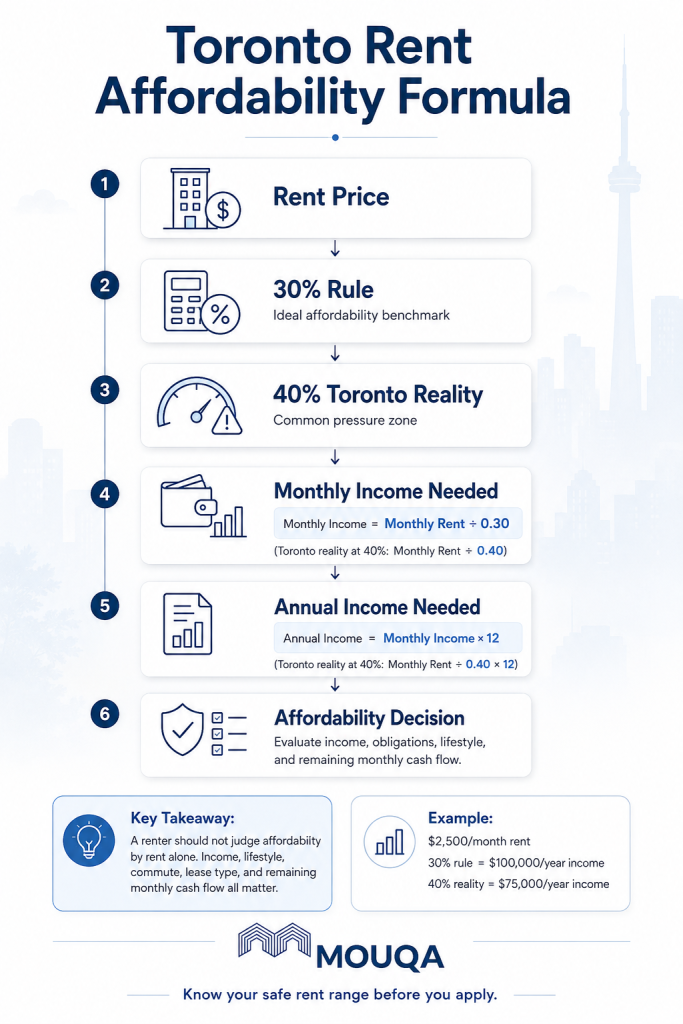
The simplest way to estimate the income needed to rent in Toronto is to compare monthly rent against monthly income.
Using the 30% Rent Rule
The traditional rule says rent should not take more than 30% of gross monthly income.
Formula: Monthly rent / 0.30 = monthly income needed
| Monthly Rent | Income Needed at 30% Rule | Approx. Annual Income |
|---|---|---|
| $1,800 | $6,000/month | $72,000/year |
| $2,200 | $7,333/month | $88,000/year |
| $2,500 | $8,333/month | $100,000/year |
| $3,000 | $10,000/month | $120,000/year |
Using the 40% Toronto Reality
In Toronto, many renters spend more than 30% of income on rent because housing costs remain high. A 40% rent-to-income ratio may be more realistic for some renters, but it creates financial pressure.
| Monthly Rent | Income Needed at 40% Reality | Approx. Annual Income |
|---|---|---|
| $1,800 | $4,500/month | $54,000/year |
| $2,200 | $5,500/month | $66,000/year |
| $2,500 | $6,250/month | $75,000/year |
| $3,000 | $7,500/month | $90,000/year |
Market Insight
The 30% rule is ideal. The 40% rule is common in high-cost rental markets. Anything above 40% can become risky unless other monthly costs are very low.
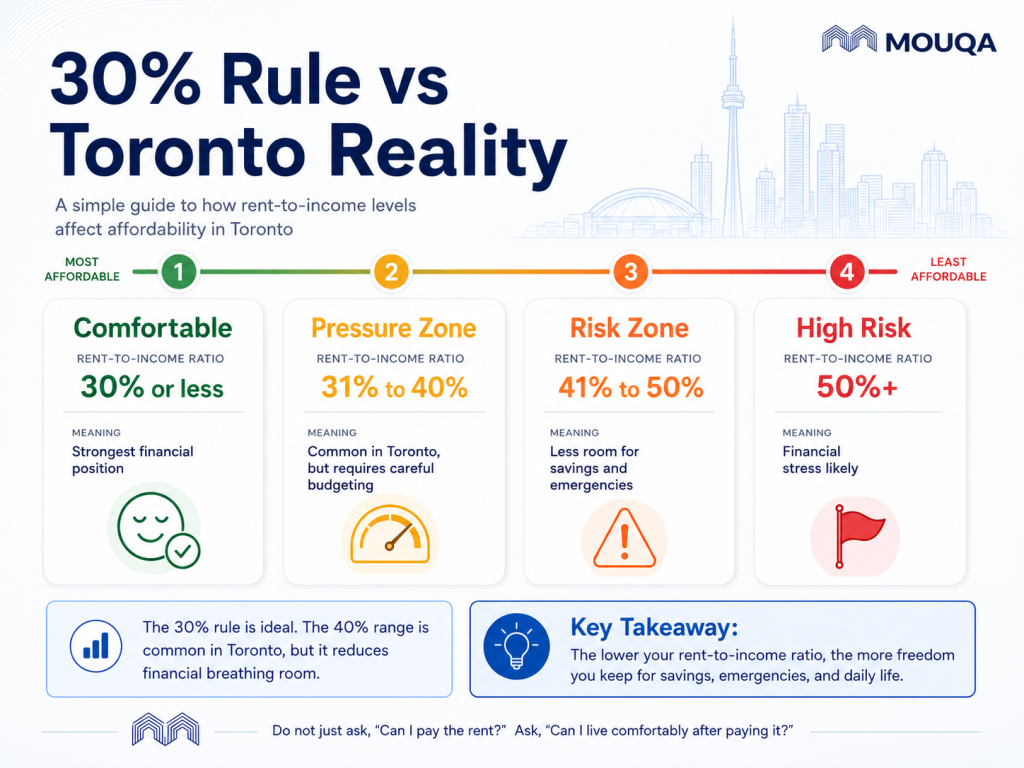
This is where many renters miscalculate affordability. They check whether they can pay rent, but they do not check whether they can still live comfortably after paying it.
Toronto Rent Affordability Trends in 2026: What Changed in the Last 12 Months?
Toronto renters are entering 2026 with more options in some rental segments, but affordability is still tight.
Key Market Signals
- Canada’s purpose-built rental vacancy rate increased to 3.1% in 2025, up from 2.2% in 2024.
- CMHC reported softer market conditions due to weaker renter household formation and increased rental supply.
- Rentals.ca reported that average asking rent in Canada fell to $2,060 in December 2025, down 2.3% year over year, reaching the lowest level in about two and a half years.
- Rents declined for the 15th straight month by December 2025, but remained 14.1% above December 2019 levels.
What This Means
The market has softened, but not equally.
Renters may find more choice in some rental segments, especially purpose-built rentals. However, desirable apartments, central locations, furnished units, and short term rental Toronto options can still create affordability pressure because they combine high demand with convenience.
What Toronto Rent Affordability Really Means in 2026
Lower rent growth does not automatically mean rent is affordable.
A $2,500/month apartment still requires:
| Affordability Rule | Monthly Income Needed | Annual Income Needed |
|---|---|---|
| 30% rent rule | $8,333/month | $100,000/year |
| 40% Toronto reality | $6,250/month | $75,000/year |
For renters comparing apartments for rent Toronto, affordability should include more than rent. You should also consider area, commute cost, lease type, listing verification, application speed, and digital leasing convenience.
Once renters know their income range, platforms like Mouqa help them compare verified listings by location and budget, connect directly with landlords, and complete application and leasing digitally.
Income Needed by Toronto Area
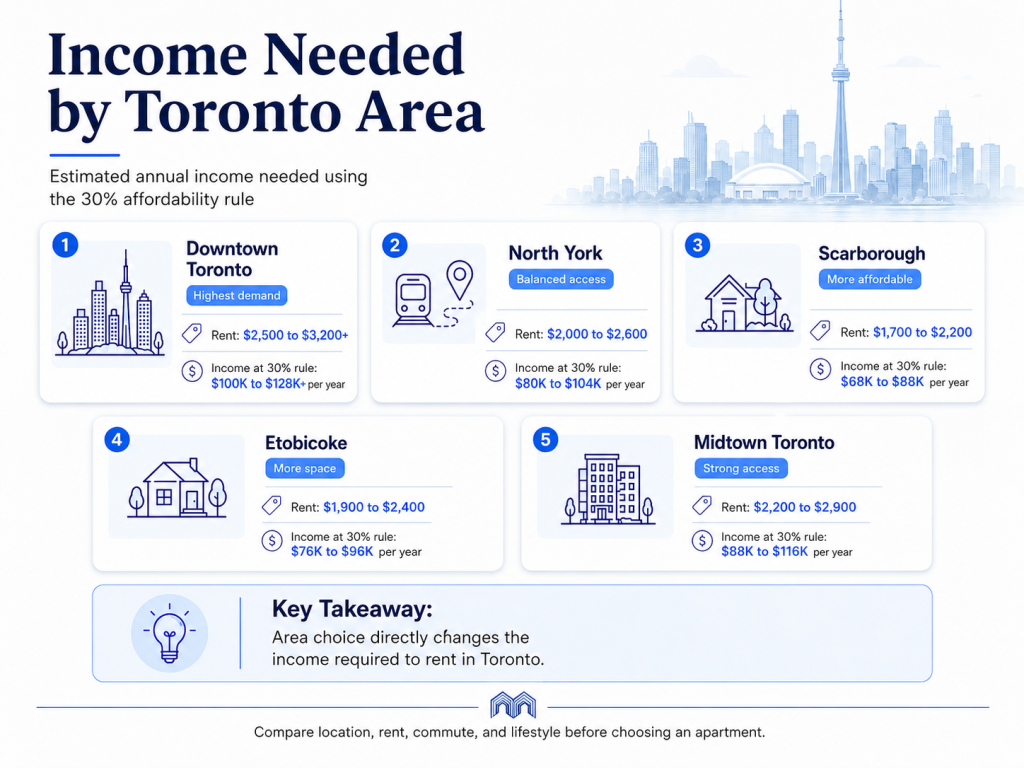
The income you need depends heavily on where you rent. Downtown Toronto usually requires the highest income, while Scarborough and parts of Etobicoke may offer better affordability.
| Toronto Area | Estimated Monthly Rent | Income Needed at 30% Rule | Income Needed at 40% Reality |
|---|---|---|---|
| Downtown Toronto | $2,500 to $3,200+ | $100,000 to $128,000+/year | $75,000 to $96,000+/year |
| North York | $2,000 to $2,600 | $80,000 to $104,000/year | $60,000 to $78,000/year |
| Scarborough | $1,700 to $2,200 | $68,000 to $88,000/year | $51,000 to $66,000/year |
| Etobicoke | $1,900 to $2,400 | $76,000 to $96,000/year | $57,000 to $72,000/year |
| Midtown Toronto | $2,200 to $2,900 | $88,000 to $116,000/year | $66,000 to $87,000/year |
Toronto-Specific Insight
Downtown Toronto may cost more, but it can reduce commute time and transportation costs. Scarborough may be cheaper, but total value depends on commute, work location, transit access, lifestyle needs, and lease type.
The cheapest rent is not always the best financial decision.
Why the 30% Rule Does Not Always Work in Toronto
The 30% rule is helpful, but it does not fully reflect Toronto’s rental reality.
A renter earning $75,000/year may technically afford a $2,500/month apartment under a 40% rent-to-income ratio, but that does not mean it is comfortable. After rent, the renter still needs to manage utilities, groceries, transit or car expenses, phone and internet, insurance, savings, and emergency costs.
Practical Insight
The real question is not only:
Can I pay this rent?
The better question is:
Can I pay this rent and still live without constant financial pressure?
That is the difference between renting and renting wisely.
The Toronto Rent Comfort Test
Before applying for any apartment for rent in Toronto, use this simple test.
| Question | Why It Matters |
|---|---|
| Can I pay rent and still save monthly? | Protects long-term financial stability |
| Is the commute worth the lower rent? | Cheap rent can become expensive in time |
| Is the listing verified? | Reduces scam risk and wasted time |
| Can I apply quickly if the apartment fits? | Strong listings can move fast |
| Does the lease type match my timeline? | Prevents being locked into the wrong rental |
Key Insight
A rental is not truly affordable if it leaves you with no flexibility.
The best rental decision balances rent, commute, timeline, application speed, and financial breathing room.
Income Needed by Rental Type
Different rental types create different income pressure.
| Rental Type | Typical Cost Level | Income Pressure | Best For |
|---|---|---|---|
| Long-term apartment | Lower monthly cost | More stable | Renters who want predictability |
| Short-term rental Toronto | Higher monthly cost | Higher pressure | Flexibility, temporary stays |
| Furnished apartment | Higher than unfurnished | Medium to high | Convenience and faster move-in |
| Condo rental | Often higher than purpose-built | High in central areas | Amenities and location |
Key Insight
A short term rental Toronto option may cost more per month, but it can make sense if flexibility prevents you from committing to the wrong long-term lease.
This matters for renters who are relocating, studying, working on temporary assignments, or testing a neighborhood before committing.
| Affordability Level | Rent-to-Income Ratio | Meaning |
|---|---|---|
| Comfortable | 30% or less | Strongest financial position |
| Pressure Zone | 31% to 40% | Common in Toronto, but requires careful budgeting |
| Risk Zone | 41% to 50% | Less room for savings and emergencies |
| High Risk | 50%+ | Financial stress likely |
Key Insight
Spending less on rent is not always smarter if it increases commute time, transport costs, and daily stress.
A slightly higher rent in the right location can sometimes be better value than a cheaper apartment that costs more in time, travel, and convenience.
How Mouqa Helps Renters Make Smarter Rental Decisions
Once you know your income range, the next step is not to browse randomly. The next step is to compare realistic options based on price, location, lease type, and application convenience.
This is where Mouqa becomes useful.
Platforms like Mouqa help renters:
- Browse verified listings
- Compare apartments by location and budget
- Connect directly with landlords
- Complete applications digitally
- Handle leasing with less back-and-forth
What Should Renters Do Next?
Before applying for an apartment, follow this simple order:
- Calculate your monthly income
- Decide your safe rent range
- Choose 2 to 3 Toronto areas
- Compare long-term, furnished, and short-term rental options
- Prepare your documents
- Use verified listings instead of scattered searches
- Apply digitally when the right apartment appears
The goal is not just to find an apartment. The goal is to find one you can afford without creating long-term financial stress.
Important Note Before Signing a Lease
This guide is for general rental planning only. Renters should consider their full monthly expenses, debt, savings goals, commute costs, and personal financial situation before signing a lease.
A rental that looks affordable on paper can still create stress if it leaves no room for emergencies or long-term planning.
Final Takeaway
To rent in Toronto, you may need anywhere from $72,000 to $120,000+ per year, depending on your rent, area, and affordability rule.
The 30% rule gives the safest estimate, but many Toronto renters operate closer to the 40% reality. That can work, but only if they understand their full monthly costs and choose carefully.
For renters searching apartments for rent Toronto, the smartest path is to calculate affordability first, then use a verified digital rental process to compare options, apply faster, and lease with less friction through Mouqa.
How much income do you need to rent in Toronto?
You usually need around $72,000 to $120,000+ per year to rent in Toronto, depending on the monthly rent and whether you use the 30% rule or a more flexible 40% affordability range.
Is $60,000 enough to rent in Toronto?
A $60,000 income may work for lower-cost rentals, shared housing, or apartments in more affordable areas, but it may be difficult for central Toronto apartments without exceeding the 30% rent rule.
How much income do you need for a $2,500 apartment?
For a $2,500/month apartment, you need about $8,333/month or $100,000/year under the 30% rent rule. At 40%, you need about $6,250/month or $75,000/year.
Can you rent in Toronto without an agent?
Yes. Platforms like Mouqa allow renters to connect directly with landlords, browse verified listings, and complete applications digitally without relying on an agent.
How can Mouqa help renters find apartments faster?
Mouqa helps renters compare verified apartments by location and budget, connect directly with landlords, and complete the application and leasing process digitally.
Leave a Reply