
The average rent in Toronto in 2026 matters, but it does not tell the full story. For renters searching for apartments for rent Toronto, the real challenge is comparing the right area, choosing the right lease type, and securing a verified listing before stronger options disappear.
Quick answer:
In 2026, renters should expect Toronto apartment rents to generally range from about $1,700 to $3,200+ per month, depending on location, apartment size, building type, furnishing, and lease length. Downtown Toronto usually sits at the higher end, while Scarborough and parts of Etobicoke tend to offer more budget-friendly options.
Why this rent guide is different
Most rent articles stop at average prices. This guide goes deeper by explaining what those prices mean for real renters in 2026. Toronto is not simply expensive. It is uneven. Some rental segments have softened, while desirable condo rentals, furnished apartments, central locations, and flexible lease options can still move quickly.
Core insight:
The best rental decision is not based on rent alone. It depends on price, location, lease flexibility, listing trust, application speed, and how easy it is to complete the process digitally.
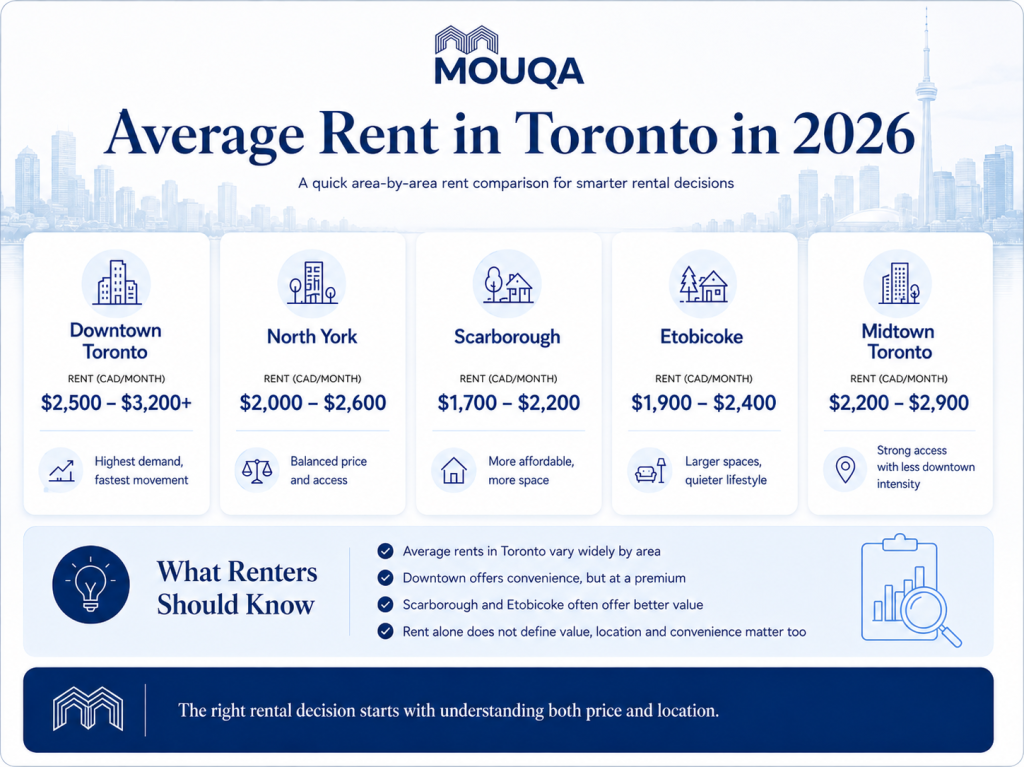
Average Rent in Toronto in 2026 by Area
The table below gives a practical market range for renters comparing common Toronto areas. These figures should be treated as guidance, not fixed prices, because rent changes based on building quality, unit size, furnishing, lease length, amenities, and current demand.
| Toronto Area | Estimated 1-Bedroom Rent in 2026 | Market Character | Best For |
|---|---|---|---|
| Downtown Toronto | $2,500 – $3,200+ | Highest demand, fastest movement | Convenience, work access, lifestyle |
| North York | $2,000 – $2,600 | Balanced price and access | Professionals, newcomers, commuters |
| Scarborough | $1,700 – $2,200 | More affordable, more space | Budget-conscious renters, students |
| Etobicoke | $1,900 – $2,400 | Larger spaces, quieter lifestyle | Families, commuters |
| Midtown Toronto | $2,200 – $2,900 | Strong access with less downtown intensity | Professionals, couples |
Expert insight
Downtown rent is not only higher because of apartment quality. It is higher because renters are paying for access: transit, work proximity, walkability, restaurants, and lower daily friction. Scarborough and Etobicoke often offer stronger space-to-price value, but commute and lifestyle costs must be included in the decision.
Toronto Rental Market Analysis: What Changed in the Last 12 Months?
Toronto’s rental market has moved from a simple “rents keep rising” story into a more nuanced market. Nationally, CMHC reported that the purpose-built rental vacancy rate rose to 3.1% in 2025, up from 2.2% in 2024. CMHC also reported that average 2-bedroom turnover rent declined in Toronto from $2,612 in 2024 to $2,547 in 2025, showing that rent pressure softened for new tenants in some segments.
For the Greater Toronto Area, CMHC reported that purpose-built rental vacancy increased to 3.0% in 2025. That was linked to lower international migration, continued competition from condominium apartment rentals, and a softer economic backdrop. However, rental condominium apartment vacancy remained much tighter at 1.0%, which means condo rentals can still be competitive even when purpose-built rentals become easier to find.
Rentals.ca also reported that Canadian asking rents ended 2025 lower year over year and that national rental demand cooled toward the end of the year. The important takeaway for Toronto renters is not that the market is suddenly easy. It is that renters have more room to compare options, but the best-value listings still reward speed, trust, and readiness.
2025 vs 2026 Rental Reality
| 2025 Pattern | 2026 Reality | What Renters Should Do |
|---|---|---|
| Renters focused mainly on price | Renters now compare price, speed, convenience, and trust | Compare total value, not only monthly rent |
| More pressure from limited supply | More options in some segments, but strong listings still move fast | Prepare documents before searching |
| Traditional agent-based searching was common | Digital rental platforms are becoming more useful | Use verified listings and digital applications |
| Long-term rentals dominated most searches | Short-term and furnished rentals remain important for flexibility | Choose lease type before comparing prices |
| Rent was the biggest concern | Verification and application convenience matter more | Avoid fake or outdated listings |
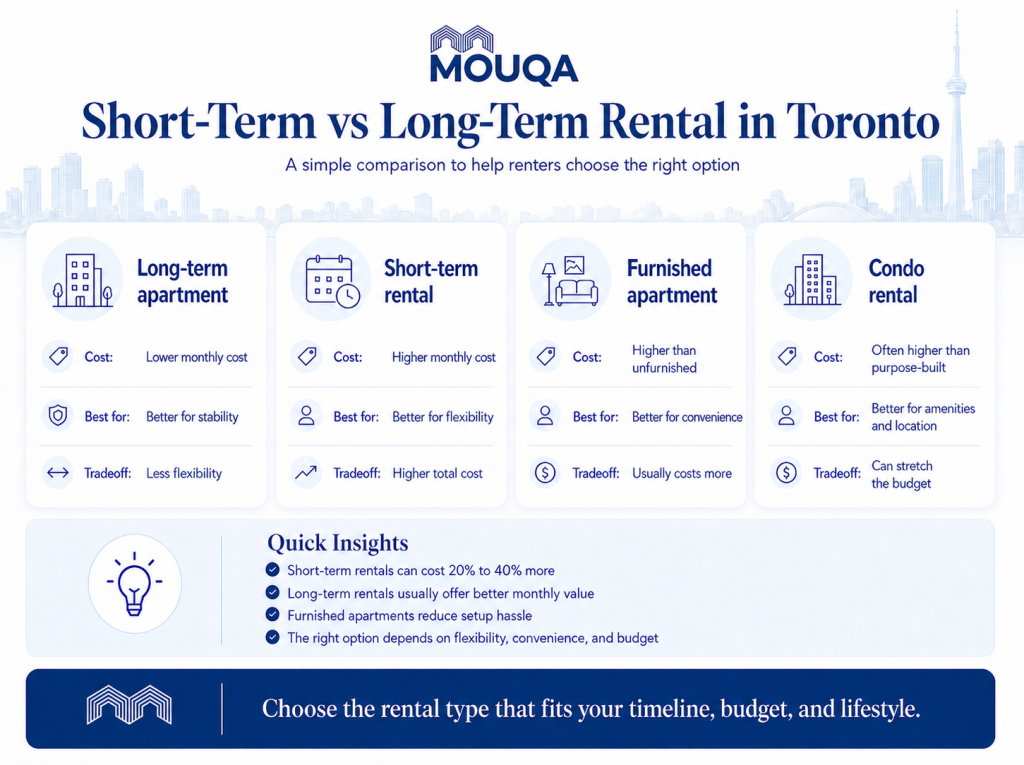
Short Term Rental Toronto: How Much More Should You Expect to Pay?
A short term rental Toronto option usually costs more than a standard long-term lease because renters are paying for flexibility, furnishing, easier move-in, and less commitment. In many cases, short-term or furnished apartments can cost 20% to 40% more than comparable long-term rentals.
That premium is not always wasted money. Short-term rentals can be useful for temporary work assignments, relocation periods, student transitions, trial stays in a new neighborhood, or situations where signing a long lease too quickly could become a costly mistake.
| Rental Type | Typical Cost Level | Best For | Main Tradeoff |
|---|---|---|---|
| Long-term apartment | Lower monthly cost | Stability | Less flexibility |
| Short-term rental | Higher monthly cost | Flexibility | Higher price |
| Furnished apartment | Higher than unfurnished | Convenience | Less personalization |
| Condo rental | Often higher than purpose-built | Amenities and location | More competition |
Downtown Toronto vs GTA: Where Is Rent More Competitive?
Downtown Toronto is usually more expensive because it offers convenience, walkability, public transit, job access, and a stronger lifestyle pull. But higher rent is not always worse value if it saves commute time and reduces daily friction.
Downtown Toronto
Best for renters who prioritize walkability, transit, career access, restaurants, and a central lifestyle. The tradeoff is higher rent and often smaller units.
North York
A balanced option for renters who want access to transit and major roads without downtown-level pricing. It can work well for commuters and newcomers.
Scarborough
Often stronger for affordability and space. It can be valuable for students and budget-conscious renters, but commute time should be considered carefully.
Etobicoke
Often offers larger units and quieter neighborhoods. It can be useful for renters who want more space, highway access, or a less central lifestyle.
Midtown Toronto
A strong middle ground for renters who want city access without the intensity of Downtown. It can offer a good balance of convenience and residential feel.
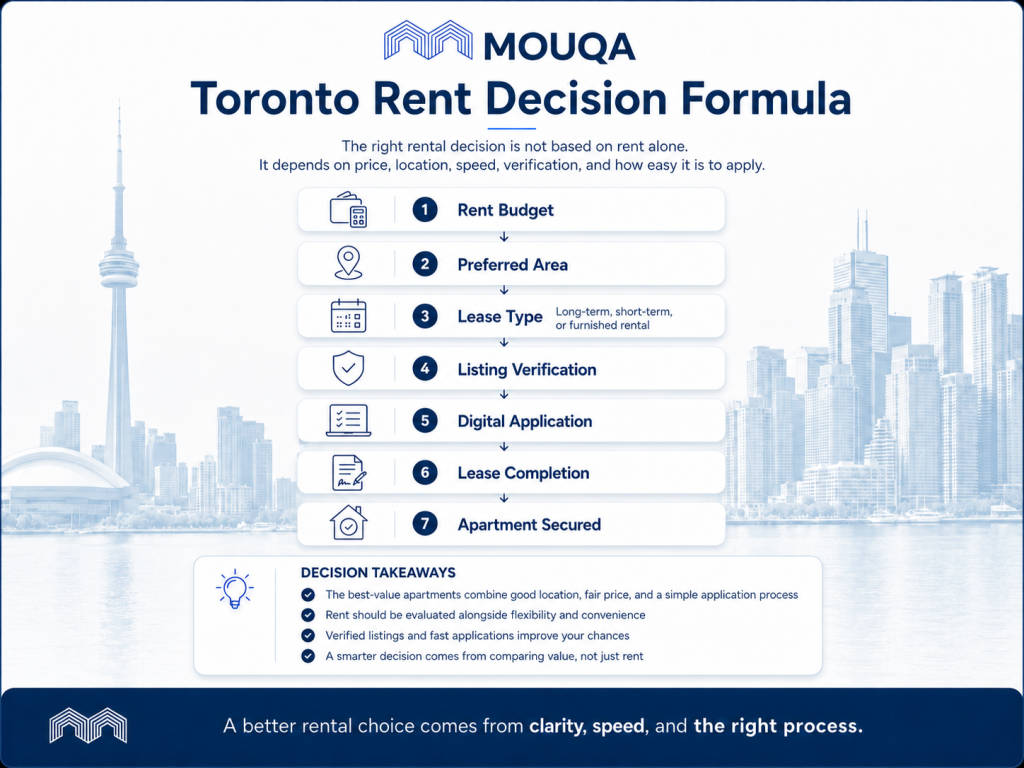
Toronto Rent Decision Formula
Use this formula before choosing a rental. It helps avoid the common mistake of judging apartments only by monthly rent.
- Rent Budget
- Preferred Area
- Lease Type
- Listing Verification
- Digital Application
- Lease Completion
- Apartment Secured
Decision Takeaway
The best-value apartments combine good location, fair price, verified listing quality, and a simple application process. A cheaper apartment can still be a bad decision if it increases commute time, paperwork friction, or risk.
Why Average Rent Alone Can Mislead Renters
Average rent is useful, but it can mislead renters when used alone. Two apartments can have the same rent but offer completely different value.
- A $2,400 Downtown apartment may save commute time and transportation costs.
- A $2,000 apartment farther away may cost more in time, transit, and inconvenience.
- A furnished short-term rental may cost more monthly but reduce setup costs.
- A verified listing may be more valuable than a cheaper unverified listing.
The smarter question is not only “What is the average rent in Toronto?” The better question is “What is the total value of this rental based on price, area, flexibility, trust, and process?”
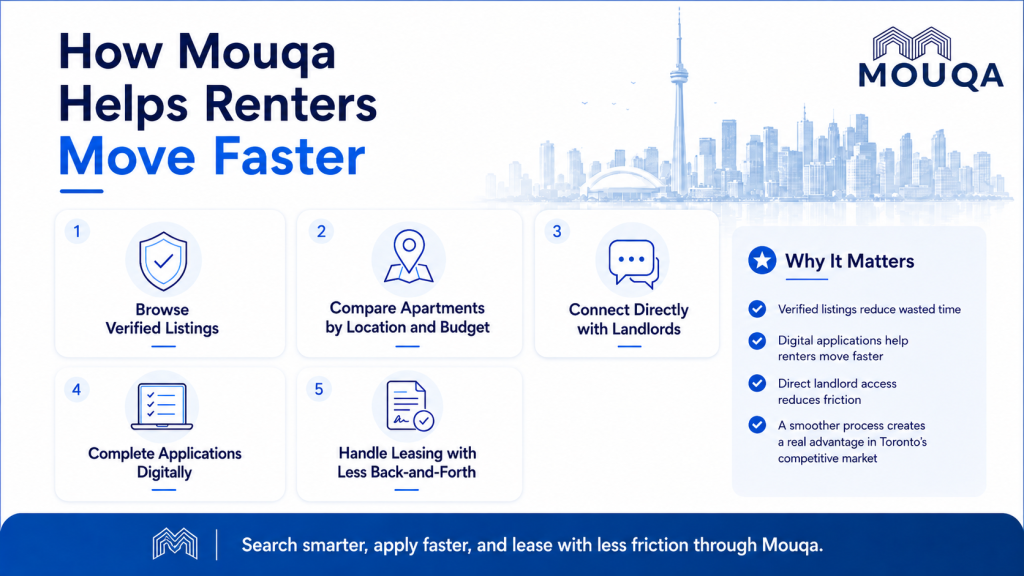
How Mouqa Helps Renters Move Faster
- Most renters waste time switching between websites, checking whether listings are real, messaging agents separately, and repeating application steps. Mouqa simplifies that journey by bringing search, verification, landlord connection, digital application, and leasing into one smoother flow.
- Browse verified listings instead of chasing outdated posts.
- Compare apartments by location, budget, and rental type.
- Connect directly with landlords to reduce delays.
- Complete applications digitally for a faster experience.
- Handle leasing with less back-and-forth and fewer manual steps.
What Should Renters Do Next?
- Decide your realistic monthly budget.
- Choose 2 to 3 preferred areas.
- Decide whether you need a long-term, furnished, or short-term rental.
- Use verified listings instead of scattered searches.
- Prepare documents before applying.
- Move quickly when the right apartment appears.
If you want a simpler way to search, compare, apply, and lease, start with Mouqa. It gives renters a more convenient digital path from apartment search to apartment secured.
Final Takeaway
The average rent in Toronto in 2026 ranges widely, but most renters should expect to see apartment rents between $1,700 and $3,200+ depending on area, unit type, building quality, and lease length.
The deeper reality is that Toronto’s rental market has softened in some segments, but the best listings remain competitive. Renters who rely only on price comparisons may move too slowly. Renters who use verified listings, digital applications, and direct landlord communication have a better chance of securing the right apartment faster.
What is the average rent in Toronto in 2026?
The average rent in Toronto in 2026 generally ranges from about $1,700 to $3,200+ per month, depending on the area, unit type, building quality, and lease length.
Are short-term rentals more expensive in Toronto?
Yes. Short-term rentals in Toronto usually cost more than long-term rentals because they offer flexibility, furnished spaces, and easier move-in options.
Is Downtown Toronto more expensive than other areas?
Yes. Downtown Toronto is usually more expensive because of its location, transit access, job proximity, and lifestyle convenience.
What is the most affordable area to rent in Toronto?
Scarborough is often one of the more affordable areas, while parts of Etobicoke and North York can also offer better value than Downtown Toronto.
How can I find apartments for rent in Toronto faster?
Use a verified rental marketplace like Mouqa, where you can browse listings, connect directly with landlords, and complete your application and leasing digitally.
Leave a Reply